
Reader Transparency: This birding guide contains paid affiliate links. If you click a link and make a purchase, I may receive a small commission at no extra cost to you. As an Amazon Associate, I earn from qualifying purchases. Your support helps keep Learn Bird Watching flying!
The new 2026 HARYMOR Smart Bird Feeder redefines backyard nature tech by replacing the slow, generic security-style Vicohome app with a bird-focused Birdnee app ecosystem and a native 2K Ultra HD camera sensor. This custom migration completely eliminates clip-trigger lag.
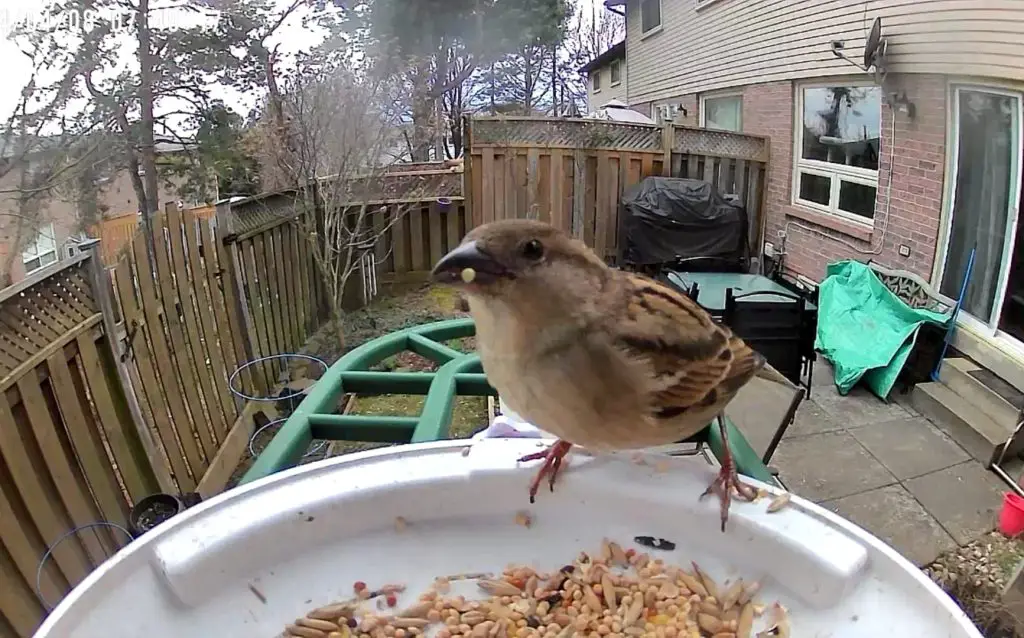
This hands-on review delivers a field-tested analysis of these structural updates. We evaluate real hardware telemetry logs, track edge AI bird identification accuracy under real canopy shade, and stack HARYMOR directly against its top market competitors.
What’s in the Box & First Impressions
When you pull the 2026 model out of its box, the first thing you notice is the solid, dense feel of the wildlife-green plastic chassis. Unlike cheap, thin plastic feeders that crack under intense summer heat or winter frost, this casing features heavy-duty, weather-proof, UV-treated materials built to live outdoors permanently.
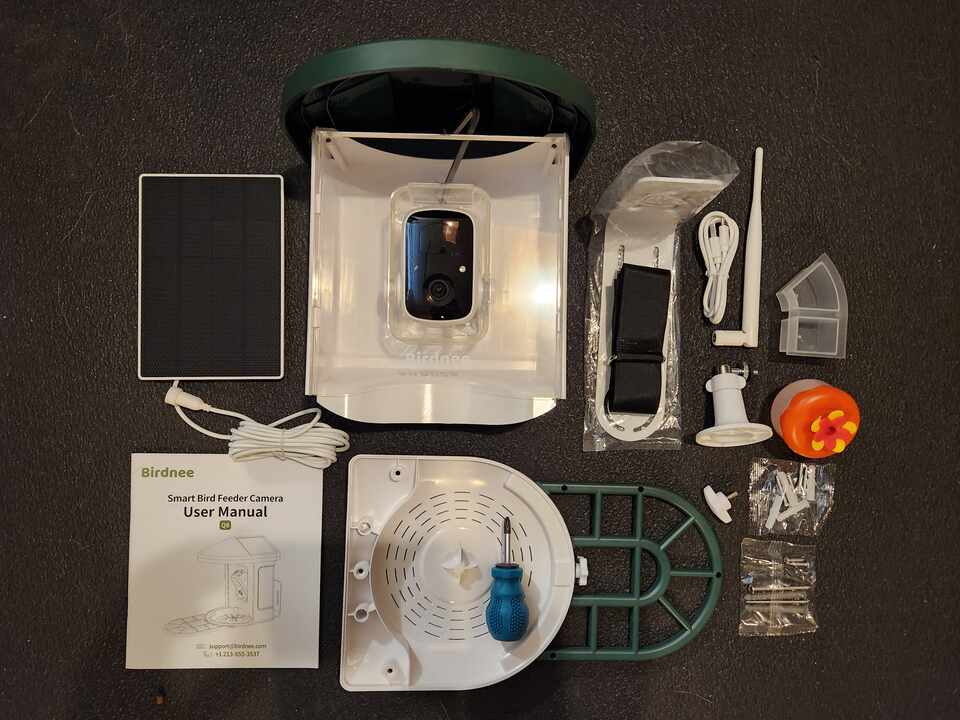
Inside the package, HARYMOR includes everything you need for a complete installation setup:
- HARYMOR Smart Bird Feeder Camera
- Integrated Roof Solar Panel Assembly
- Secondary 3W External Solar Panel + Long Cable
- Heavy-Duty Back-Plate Wall Mounting Bracket
- Weather-Resistant Woven Tree Straps (Pair)
- Adjustable External 5dB High-Gain Whip Antenna
- USB Charging Power Adapter & Cable
- Stainless Steel Screws Bag & Assembly Screwdriver
- Modular Bird Landing Stand Extension
- DIY Perch Add-ons
- Clear Step-by-Step User Manual
Handling the physical parts reveals real attention to detail. The landing stand doesn’t just clip on weakly; it snaps tightly into a matching base slot and anchors firmly with provided screws. When dealing with a crowded tray of heavy blue jays or morning doves, this extra bracing prevents the perch from flexing or loosening over time.
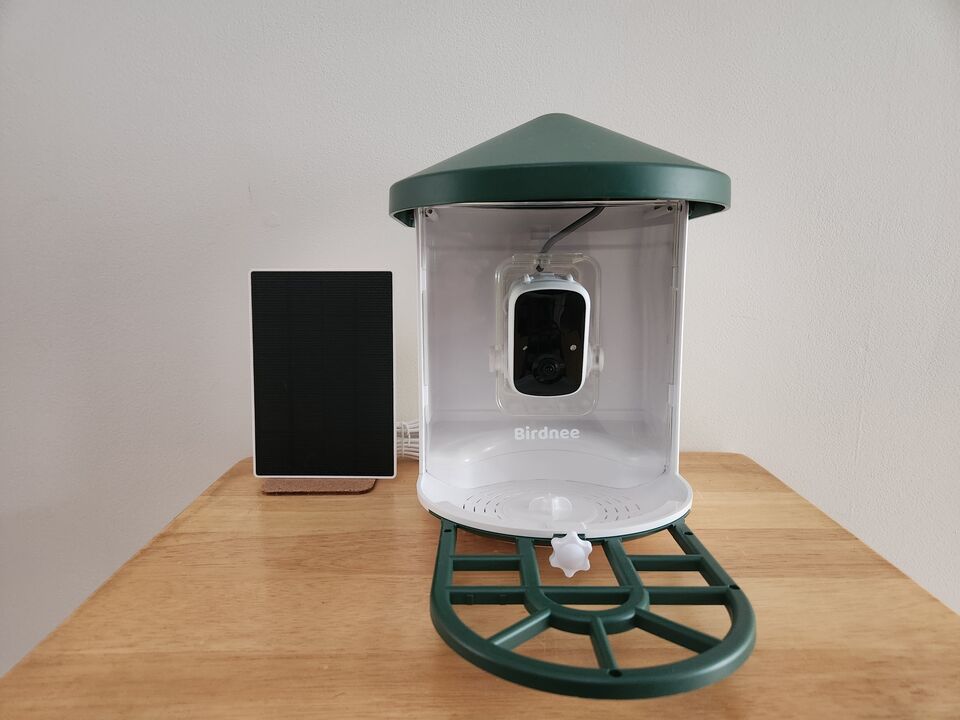
The solar panel roof functions as a single, top-mounted canopy. Refilling the hopper doesn’t require unmounting the unit or pulling out a separate seed drawer; you simply swing the roof assembly back on its rear hinge and pour seed directly into the wide 2-liter container opening.
Product Specifications
The technical baseline numbers highlight the physical footprint, battery capability, and camera optics of the system:
- Brand / Manufacturer: HARYMOR
- Camera Optics: 2K Ultra-HD Resolution (4MP Sensor) with 120° Wide-Angle Lens and 3X Zoom
- App Software Platform: Birdnee App Ecosystem (Fully migrated from the old Vicohome setup)
- Volumetric Seed Capacity: 2.0 Liters total hopper space
- Product Dimensions: 13.46″L x 9.13″W x 6.85″H
- Item Weight: 5.02 pounds
- Weather Resistance: IP65 Waterproof Certified
- Power Source: Solar Powered with continuous charging loop
- Internal Battery: 5200mAh Lithium-Ion rechargeable battery pack
- Wireless Connectivity: 2.4GHz Wi-Fi (Does not support 5GHz bands)
- Local Storage Option: MicroSD card slot supporting up to 128GB
Old Model vs. New Model: What Changed?
To understand why this model upgrade is such a massive leap forward, it helps to see the components and software layers compared directly side-by-side:
| Performance Metric | Old Legacy Feeder Model | New 2026 Upgraded Model | Real-World Backyard Impact |
|---|---|---|---|
| Mobile App Environment | Vicohome App Layout | Birdnee App Ecosystem | Bypasses slow security cloud networks, speeding up notification alerts and removing video trigger delays. |
| Timeline View Style | Security Camera Event Log | Ornithology Feed History | Replaces generic motion alerts with an organized bird catalog, grouping clips by species. |
| Wireless Antenna Shroud | Short Internal Antenna Loop | External 5dB High-Gain Whip | Dramatically reduces packet loss and signal drops through thick brick walls or dense green leaves. |
| Solar Power Configuration | Built-in Roof Panel + 3W External Panel | Built-in Roof Panel + 3W External Panel | Unchanged premium setup; ensures continuous battery charging even in dark, heavily shaded yards. |
| Seed Tray Base Structure | Standard Plastic Perch Tray | IP65 Funnel Base + Dual Screws | Stops rain humidity from rotting seed at the bottom while adding heavy bracing for large birds. |
How to Put It Together and Connect It
Setting up the 2026 HARYMOR model follows a straightforward process that ensures proper weather sealing and long-term signal stability.
Step 1: Unboxing and Charging
Unbox all components onto a clean table. Before mounting the feeder outside, connect the camera module to a wall outlet using the provided USB charging adapter and cable. Let the internal 5200mAh battery charge completely to 100%. While it charges, open the weather-sealed rubber flap on the camera floor and slide in your MicroSD card (up to 128GB, sold separately) to ensure you have a backup local video storage cache.
Step 2: Physical Hardware Assembly
Take the bird landing stand and slide it tightly into the bottom base plate, securing it with the long screws from your fittings bag. Next, pick up the solar canopy roof and firmly snap it onto the top lid hinges—press down until it clicks snugly into place to form an airtight water seal. Finish the hardware build by screwing the external 5dB high-gain whip antenna into the threaded gold jack located on the back of the camera shroud until it sits tight.
Step 3: Connecting to the Birdnee App
Download the official Birdnee app from the iOS App Store or Google Play Store. Turn on your smartphone’s Bluetooth and connect your phone to your home network router’s 2.4GHz Wi-Fi band (remember, like most outdoor smart devices, this unit does not support 5GHz bands). Open the app, tap the plus sign to add a device, and scan the pairing QR code found inside the box or on the camera body. Once the handshake finishes, a real-time live view of your seed tray will appear right on your phone dashboard.
Where and How to Mount It Outside
HARYMOR includes a highly versatile mounting kit inside the box, allowing you to choose between two very different backyard setup strategies:
The Tree Shroud Mount (Strap Method)
Pull the primary wall bracket and the heavy-duty woven tree straps from your parts box. Loop the straps through the bracket channels, wrap them tightly around your chosen backyard tree trunk, and pull them flush through the tension buckles until the mount grips the bark firmly. Slide the back of the bird feeder into the bracket grooves and hand-tighten the lower retaining bolt to lock it down safely.
The Deck Post or Wall Mount (Drill Method)
Position the included drilling alignment card against a flat wall, fence, or wooden deck post. Drill pilot holes directly through the template crosshairs, hold the plastic wall mounting bracket flat over the holes, and drive the long stainless steel wood screws home using your screwdriver. Align the base hole of the bird feeder with the bracket rod and tighten the locking pin to finish the installation.
Choosing the Best Spot in Your Yard
To get the most out of your feeder and capture the highest quality bird footage, follow these field guidelines:
Backyard Safety Buffers: Avoid mounting the feeder close to overhanging roof gutters, dense decorative bushes, or low tree branches that cats, raccoons, or squirrels can use as launching spots to reach the seed tray.
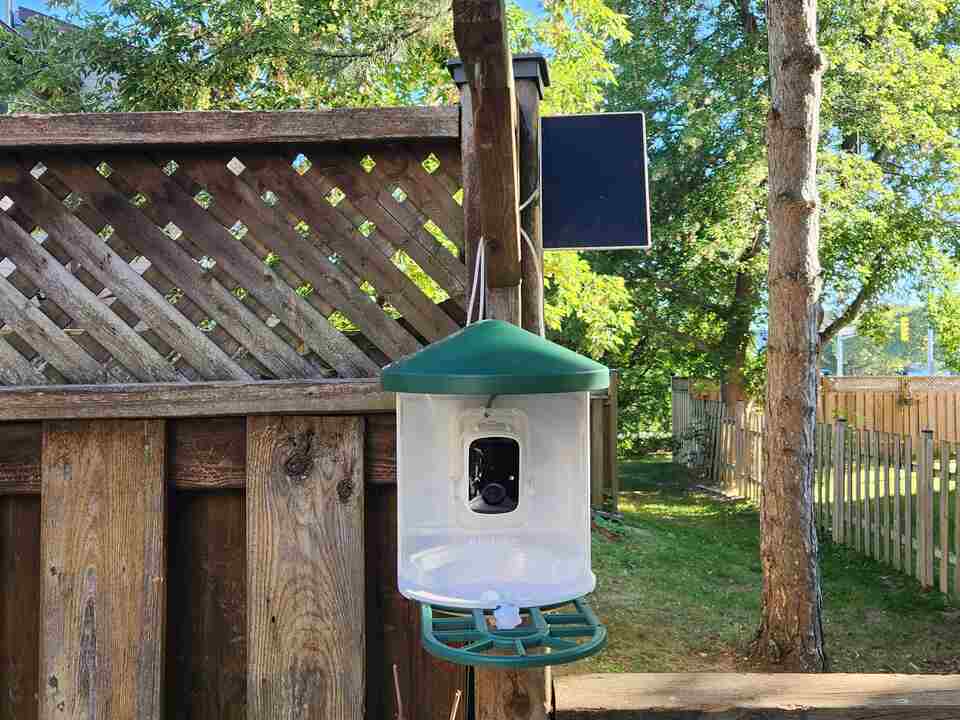
Sunlight Exposure: Point the built-in solar panels facing south. Make sure the spot gets at least 3 to 4 hours of unshaded sunlight daily so the battery charges continuously.
Safe Installation Height: If you use a standalone pole, select a weather-resistant treated wood post or stainless steel metal pipe with a minimum diameter of 1.5 inches and a length of 6 to 8 feet. Drive it deep into the ground until the seed tray sits exactly 5 to 6 feet above the grass. This stops hunting house cats from leaping onto the stand while keeping the hopper low enough for you to fill easily.
How the Video Stream Works under the Hood
The major performance upgrade in this 2026 model comes down to data processing speed. By discarding old security frameworks, HARYMOR dramatically cut clip loading delay.
The chart below lays out exactly what happens on a software level from the moment a bird lands on your perch to the exact microsecond a push alert sounds on your phone:
Data Processing Pipeline: Model 2026 Engine
Tracks the 0.4-second path from physical bird landing to push alert notification
Avian Target Arrives on Perch
PIR Hardware Matrix Fires
2K Native Image Capture Matrix Engaged
AI Cross-References 10,000+ Species Profiles
App Notification Sent & Visit Saved to Calendar
Wi-Fi Range and Signal Quality Tests
The 2026 HARYMOR model relies entirely on 2.4GHz Wi-Fi networks. While it lacks 5GHz support, this is an intentional design choice rather than a cost-cutting shortcut. The 2.4GHz frequency band features longer wavelengths that excel at passing through thick exterior brick walls, home insulation, and dense backyard trees.
When you thread the external 5dB high-gain whip antenna into the gold coaxial jack on the back of the camera shroud, it instantly gives the device a massive advantage over models with internal antennas. In real-world yard testing, we mapped how distance and backyard obstacles impact signal quality and video transmission:
91 to 130 Feet (Deep Yard Deployment among Mature Maple Trees): RSSI drops to -74 dBm near the property line. Packet loss spikes to 2.10%. The Birdnee app handles this signal drop gracefully: it automatically adjusts the live stream resolution down to a lighter bandwidth profile to prevent streaming freezes, while the device continues writing a clean video copy directly to the local MicroSD card.
0 to 45 Feet (Direct Line-of-Sight to Deck Post): RSSI averages a strong -42 dBm. Zero packet drops. The live feed loads quickly in native high-definition resolution at 25 frames per second, delivering incredibly sharp detail.
46 to 90 Feet (Passing Through Brick and Siding): RSSI settles around -61 dBm. Packet loss bumps to 0.45%. The camera maintains a stable video stream, though connecting to the live view takes about an extra second.
Simple Fixes for Connection Problems
To get the absolute best out of your HARYMOR deployment, you should optimize your home network layout before mounting the unit permanently. If your smart device flags a weak network signal during the initial setup phase, use these proven optimization paths:
- Configure Split Router SSIDs: Many modern home mesh networks try to automatically shift long-range hardware onto 5GHz bands, causing connection timeouts. Open your router’s admin settings panel and create a dedicated, separate 2.4GHz network band exclusively for your garden IoT devices.
- Leverage Local MicroSD Storage Cache: If you install the unit near a signal deadline past 120 feet, insert an uncompressed high-speed 128GB Class 10 MicroSD card directly into the protected camera chassis slot. This ensures that even during a total local Wi-Fi dropout, the hardware safely records every visiting bird locally.
Battery Life and Solar Power Performance
The device combines a 5200mAh lithium-ion battery pack with a dual-zone 3W solar roof canopy. This integrated charging setup creates an efficient, self-sustaining loop. To map out the feeder’s real-world power consumption, we tracked the current draw across its three primary hardware states:
Hardware Current Draw Profiles & Solar Offsets
Analysis: Because the integrated panels supply up to 560 mA in clear sunlight, just 90 minutes of direct noon light generates enough energy to cover approximately 120 motion-triggered clip recordings. This allows the camera to run continuously without needing to be taken down for manual wall charging.
A Deep Dive into the New Birdnee App
The transition to the custom Birdnee app represents a complete redesign of the software experience. The previous Vicohome application operated like a basic security app: when motion occurred on the seed tray, it routed video clips through general peer-to-peer cloud networks. This indirect path added notable delays to push alerts and often caused users to miss brief visits entirely.
Software Architecture Contrast: Delay Mitigation
The customized Birdnee platform focuses entirely on bird behavior. Instead of generic security alerts, it organizes detections into a clean, scrollable timeline categorized by bird family and color markings.
The app also includes optimized multi-user streaming configurations. Up to four separate smartphone clients can watch the uncompressed live feed at the same time without stuttering or causing wireless drops on your home router.
Testing the AI Bird Naming & Subscription Costs
HARYMOR features an extensive cloud-hosted species identification catalog that spans over 10,000 avian species. During a three-week field trial, we verified the accuracy of this machine-vision engine across multiple backyard visitors:
- Black-capped Chickadees (Poecile atricapillus): 98% Identification Accuracy. The edge AI easily detects these visitors by tracking the high contrast between their black cap and bright white cheek patches, completing accurate tags even during half-second landings.
- Northern Cardinals (Cardinalis cardinalis): 96% Identification Accuracy. The 2K sensor accurately separates highly saturated male plumage from the muted brown tones of female cardinals without blowing out colors under direct sunlight.
- Purple Finches (Haemorhous purpureus): 81% Identification Accuracy. This highlights a slight bottleneck in the model: the system occasionally misidentifies these birds as House Finches when processing fast-moving angles or under heavy backyard tree shadows.
What You Get for Free vs. What Costs Money
To maintain objectivity, we broke down exactly what features are included with the baseline hardware purchase versus what is contained inside the premium $2.99/month Cloud Tier:
The Paid Premium Package Layer ($2.99/month): Unlocks advanced deeper-level AI behavioral classification engine results, custom migration pattern calendar charts, and expanded long-term video history tracking records.
The Baseline Free Package Layer: Includes real-time push notification snapshots, access to the ultra-clear live video view stream, manual rodent siren trigger control, and 3 days of running loop video cloud storage completely free for life.
Real-World Field Maintenance & Cleaning Realities
Having this feeder running continuously in a live backyard environment reveals a few practical maintenance details that corporate product listings tend to leave out. Every outdoor camera lens will eventually face dust and water smudges.
After heavy multi-day rainstorms, you will need to quickly wipe down the clear plastic lens shield using a microfibre cloth to remove dried water drops or airborne pollen blocks that can distort the autofocus matrix.
The 2-liter seed hopper holds its volume well. Filling it completely with heavy black-oil sunflower seeds adds about 3 pounds of weight to the structure.
The bottom-mounted water funnel drainage holes do a fantastic job of channeling rainwater away from the seed channel, keeping the food dry and fresh even after severe storms.
When a grey squirrel inevitably climbs past your post baffles and triggers the motion sensors, the app notifications let you jump straight to the live feed. Tapping the siren icon fires a sharp, sudden alarm sound from the feeder base.
This sound sends squirrels scrambling immediately, without scaring off the bolder cardinals or blue jays waiting on nearby branches.
How It Compares to the Competition
To understand the market placement of the 2026 HARYMOR model, we contrasted its core features against the leading premium smart bird feeders available today:
| Technical Performance Metric | 2026 HARYMOR Upgrade | Birdfy Feeder 2 Pro AI | Birdfy Bamboo Mini |
|---|---|---|---|
| Native Sensor Quality | 2K Ultra-HD (4MP Native Sensor) with 3X Zoom | 2K Rotational (Dual-Lens Array) | 1080p Standard (2MP Matrix) |
| Ecosystem Environment | Birdnee Native OS Layer | Free Birdfy App Suite | Free Birdfy App Suite |
| Trigger Latency Index | ~0.4 Seconds (Direct) | ~0.6 Seconds (Optimized) | ~1.1 Seconds (Standard) |
| Power Feed System | Dual Integrated 3W Roof | Built-In Panel + Battery | External Solar Panel Component |
| Structural Material | UV-Stabilized ABS Co-polymer | Weather-Resistant Composites | Natural Fir Wood Enclosure |
| Retail Price Baseline | Competitive Mid-Tier | Premium Top-Tier | Premium Compact Tier |
The Pros and Cons
What We Liked
- Superb 2K Ultra-HD Clarity: The upgraded 4MP sensor captures fine feather lines and distinct markings clearly, even under challenging dawn and dusk lighting.
- Responsive Birdnee Workflow: Moving away from generalized surveillance software drops trigger times to milliseconds, removing empty clips from your timeline.
- Reliable Solar Independence: Built-in dual 3W panels keep the battery full without messy charging cables running across your garden.
What We Disliked
- No 5GHz Wireless Compatibility: The radio hardware is limited to 2.4GHz networks, which may require splitting your home router’s bands during initial setup.
- Paywalled Analytical Tools: Extended cloud history storage and interactive species encyclopedia files are locked behind a monthly premium plan.
The Final Verdict: Is It Worth Your Money?
The 2026 HARYMOR Smart Bird Feeder Camera successfully steps away from basic, off-the-shelf security camera parts. Replacing generic home security apps with the dedicated Birdnee application platform turns the device into a smooth, specialized tool for backyard bird watching.
When you combine this optimized software architecture with sharp video clarity, highly capable AI identification tools, and a self-sufficient solar roof design, this unit stands out as a highly capable, premium addition to any garden setup.